How to Record Accidents at Work: A Complete Guide to Accident Reporting and RIDDOR Compliance
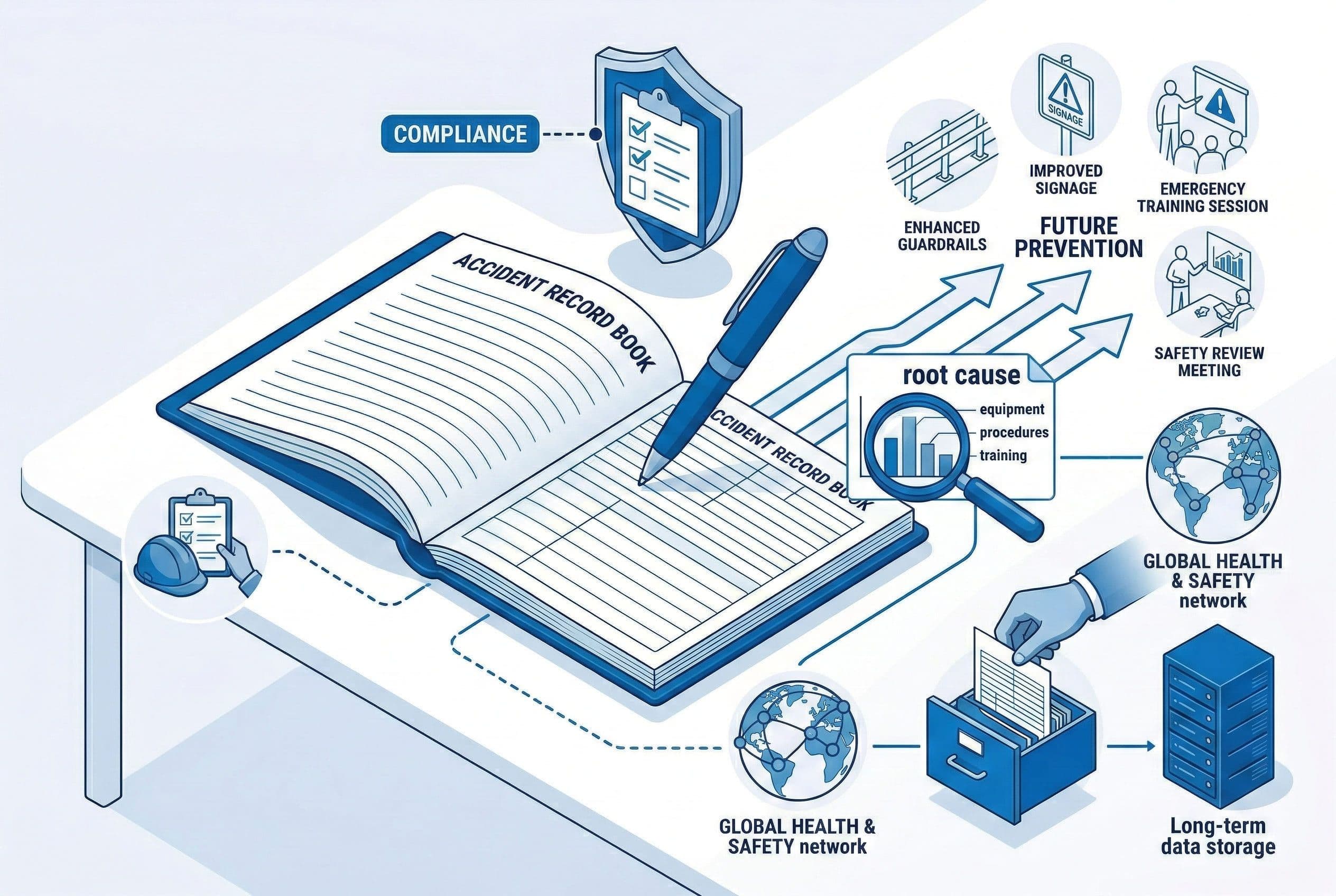
Understanding your legal obligations, what to include in accident reports, and how proper documentation prevents future incidents
Knowing how to record accidents at work is a fundamental aspect of maintaining workplace health and safety. According to the Health and Safety Executive (HSE), 124 workers were killed at work in the UK between 2024 and 2025. While the priority must always be preventing accidents from happening in the first place, recording them accurately when they do occur is equally important. Proper documentation supports legal compliance, protects employee wellbeing, and provides vital data for preventing future incidents.
Many organisations struggle with accident recording. Some fail to document incidents properly, leaving themselves exposed to legal risk. Others record information but fail to use it effectively to drive improvements. This guide explains the legal requirements for accident recording, what information to include, and how to use accident data to make your workplace safer. Whether you operate solely in the UK or manage international health and safety consultants across multiple countries, the principles of effective accident recording remain consistent.
Why Recording Workplace Accidents Matters
Accident recording serves multiple important purposes. It is not simply a bureaucratic requirement but a valuable tool for protecting your organisation and your people.
Legal compliance: Under the Reporting of Injuries, Diseases and Dangerous Occurrences Regulations 2013 (RIDDOR) and the Social Security (Claims and Payments) Regulations 1979, employers have legal obligations to record and report certain workplace accidents. Failure to comply can result in enforcement action and fines.
Evidence for investigations: Accurate records provide essential information for accident investigations. They help identify root causes and contributing factors, enabling organisations to implement effective preventive measures.
Protection in legal proceedings: If an accident leads to a compensation claim or prosecution, contemporaneous records provide crucial evidence. Poor or missing records can seriously undermine an organisation's defence.
Trend identification: Analysing accident records over time reveals patterns and trends. This allows organisations to focus resources on the most significant risks and measure whether safety improvements are working.
Insurance requirements: Employers' liability insurers require proper accident records. Failure to maintain adequate records can affect claims and policy validity.
Legal Requirements for Accident Recording in the UK
RIDDOR Requirements
Under RIDDOR, employers, the self-employed, and people in control of work premises must report and keep records of certain work-related accidents, diseases, and dangerous occurrences. Most accidents must be reported within 10 days of the incident. If the injured person is incapacitated for more than seven consecutive days (not including the day of the accident), the incident must be reported within 15 days.
RIDDOR-reportable incidents include:
- Deaths
- Specified injuries, including fractures (other than fingers, thumbs, and toes), amputations, and injuries causing permanent loss of sight
- Over-seven-day incapacitation where the worker is unable to perform their normal duties for more than seven consecutive days
- Injuries to non-workers (members of the public) who are taken directly to hospital for treatment
- Certain occupational diseases
- Dangerous occurrences, including near misses with the potential to cause serious harm
Accident Book Requirements
An accident book is a legal requirement for businesses with 10 or more employees. Businesses operating quarries or mines must also maintain an accident book regardless of the number of employees. Even where not legally required, maintaining an accident book is strongly recommended as good practice for organisations of any size.
The accident book should be stored somewhere safe and secure but easily accessible to all employees. Common locations include the reception area, staff room, first aid room, or the health and safety manager's office. Since accident records contain personal data, they must be managed in accordance with data protection requirements.
What to Include in an Accident Report
An accident report should be completed as soon as possible after the incident, ideally by a supervisor or manager. The primary aim is to document what happened, when it happened, who was involved, and the resulting injuries and aftermath. The report serves as a reliable account that can be referred back to when reviewing health and safety procedures, conducting health and safety audits, creating risk assessments, or handling insurance claims.
Key information to record includes:
- The injured person's full name, job title, and date of birth
- The date, time, and precise location of the accident
- Details of the injury sustained, such as cuts, bruises, fractures, or strains
- A factual account of how the accident happened, including the activity being carried out at the time
- The action taken, including any first aid administered, further medical attention sought, or emergency services attendance
- Whether the injured person is pregnant or has any relevant pre-existing conditions
- The full name and job title of the person completing the report
- Witness statements with names and contact details
- Photographs of injuries, the accident scene, and any relevant equipment
Witnesses should be asked for their account at the earliest opportunity while information is fresh. First aiders who attended should document the care they provided. For significant injuries or dangerous occurrences, this initial record forms the basis for a more detailed accident investigation.
International Accident Recording Requirements
Organisations operating internationally face varying accident reporting requirements across different jurisdictions. While the specific regulations differ, the fundamental principles remain consistent: employers must record workplace accidents, report serious incidents to relevant authorities, and use accident data to prevent future harm.
In the European Union, the Framework Directive 89/391/EEC requires employers to keep records of occupational accidents resulting in incapacity for work exceeding three working days. Individual member states implement this through national legislation with varying specific requirements. In the United States, OSHA requires employers to record work-related injuries and illnesses meeting certain criteria and to report fatalities and severe injuries within specified timeframes.
For global health and safety consultants supporting multinational organisations, developing a consistent accident recording system that meets the requirements of all applicable jurisdictions is essential. ISO 45001 provides a framework for managing occupational health and safety that includes requirements for incident investigation, regardless of local regulatory requirements.
Health and Safety Consultants and Software: Digital Accident Recording
While traditional paper-based accident books remain legally acceptable, many organisations are moving to digital accident recording systems. Health and safety software offers significant advantages over paper records, particularly for organisations with multiple sites or those working with international health and safety consultants.
Benefits of digital accident recording include:
- Immediate accessibility from any location, supporting remote and multi-site operations
- Automatic alerts and reminders for RIDDOR reporting deadlines
- Built-in analysis tools for identifying trends and patterns
- Secure storage with controlled access and audit trails
- Integration with other health and safety management functions
- Easy generation of reports for management, health and safety audits, and regulatory purposes
From Recording to Prevention: Using Accident Data Effectively
Recording accidents is only the first step. The real value comes from using that data to prevent future incidents. Every accident, no matter how minor, is an opportunity to learn and improve.
Effective use of accident data involves:
- Investigating all accidents to identify root causes, not just obvious immediate causes
- Implementing corrective actions that address underlying weaknesses in systems and procedures
- Tracking the completion and effectiveness of corrective actions
- Regularly reviewing accident statistics to identify trends and problem areas
- Updating risk assessments based on accident findings
- Sharing lessons learned across the organisation
- Including accident statistics in health and safety audits and management reviews
How Arinite Can Help
At Arinite, we are experienced health and safety consultants who help organisations manage all aspects of workplace safety, including accident recording, investigation, and prevention. Our team of Chartered (CMIOSH) consultants provides practical, proportionate advice that helps you comply with legal requirements while building a genuinely safer workplace.
Our services include:
- Accident reporting systems and procedures tailored to your organisation
- RIDDOR compliance advice and support with reporting
- Accident investigation services to identify root causes and preventive measures
- Health and safety audits to assess your overall safety management arrangements
- Risk assessments informed by accident data and industry experience
- Training for managers and employees on accident reporting and investigation
- Support for international operations as global health and safety consultants
With experience supporting over 1,500 UK businesses and operations in more than 50 countries, we understand the challenges of managing accident recording across diverse workplace settings. Whether you need help establishing systems from scratch, improving existing processes, or investigating a specific incident, our approach is practical, proportionate, and focused on preventing future harm. We call it "Keeping It Simple."
Written by